A hidden leak usually turns up on the water bill before it turns up on a wall. By the time there is a damp patch or paint bubbling, it has been running quietly for a while.
The good news is you can find out whether you have one without a plumber, without tools, and without opening anything up. It takes about two minutes and the answer is yes or no.
The meter test, step by step
- Turn everything off. Every tap inside and out, the dishwasher, the washing machine. If you have an irrigation system or a pool with an auto-filler, those too. Nothing should be using water.
- Find the water meter. Usually in a small box near the front boundary.
- Look at the dial. Most meters have a small spinning indicator for very low flow, often a red or black triangle or star. Write down the full reading as well.
- Wait. Two minutes is enough if the leak is reasonable in size. Half an hour is better for a slow one.
- Look again. If that indicator has moved at all, water is going somewhere.
That is the whole test. No water should be moving through a meter when nothing in the house is on.
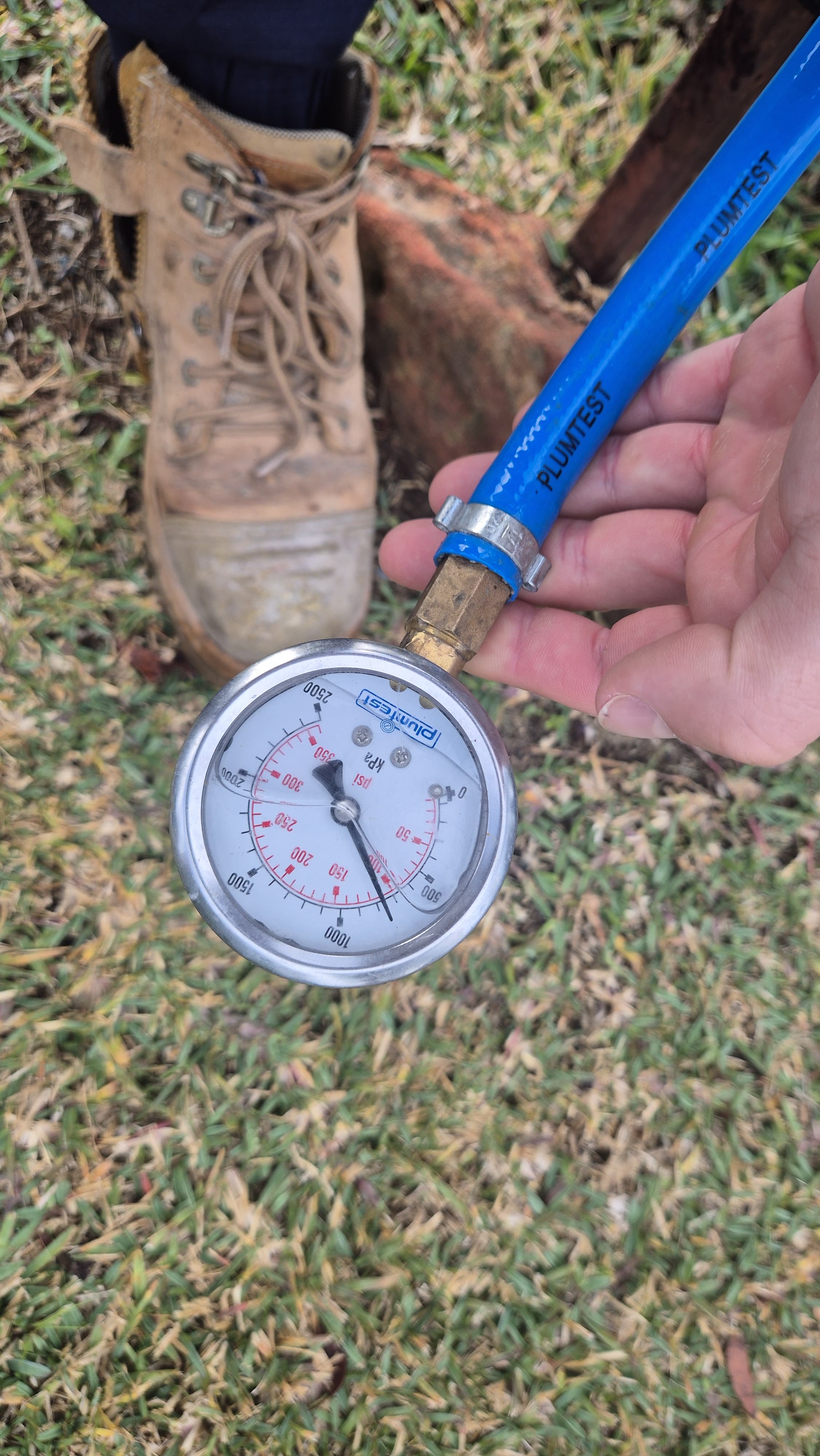
Once the meter says there is a leak, pressure testing narrows down which line it is on.
What the result actually tells you
The indicator did not move. No leak on your side of the meter right now. If your bill still jumped, the cause is usually something that ran rather than something that leaks, a toilet that was sticking, a tap left on, or a season of filling a pool.
It moved slowly. Something small. A toilet cistern weeping into the bowl is the most common culprit by a distance, and it is also the easiest to test. Put a few drops of food colouring in the cistern, leave it half an hour without flushing, and if colour appears in the bowl the outlet valve is passing.
It moved steadily. A real leak, and worth acting on rather than watching. At this point it is worth knowing where it is before anyone starts cutting.
The other signs
- A water bill that jumped with nothing in the house changing
- A damp patch, a musty smell, or paint bubbling on a wall
- A section of floor that is warm underfoot, which usually means a hot water line
- Water pressure that has quietly dropped off
- Mould coming back in the same corner no matter how often it is cleaned
Why the test is worth doing before you ring
Knowing there is a leak changes the job. It means nobody is guessing about whether something is wrong, only about where, and the meter has already answered the first half of the question for free.
From there it is pressure testing to narrow down which line it is on, isolating sections until the drop points at one of them. The point of doing it properly is that you only open up the part of the wall or slab that actually has the problem in it, rather than pulling a wall apart on a hunch.
One thing the test will not tell you
Not everything wet is a leak. Water coming up through a floor waste or a shower drain is usually a blocked drain rather than a pipe letting go, and that is a different job with a different fix.
The meter test separates the two neatly. A blocked drain does not move your water meter, because the water is yours already and is simply not going away. If the meter is still then the problem is drainage, and a drain that keeps blocking in the same spot is usually telling you something about the pipe.
If the meter is ticking
I find leaks across Castle Hill and the Hills District without guessing where to start cutting. There is more on how that works on the leak detection page.
If the meter was still but your hot water has been behaving strangely, the signs a hot water system is on the way out is the more useful read.