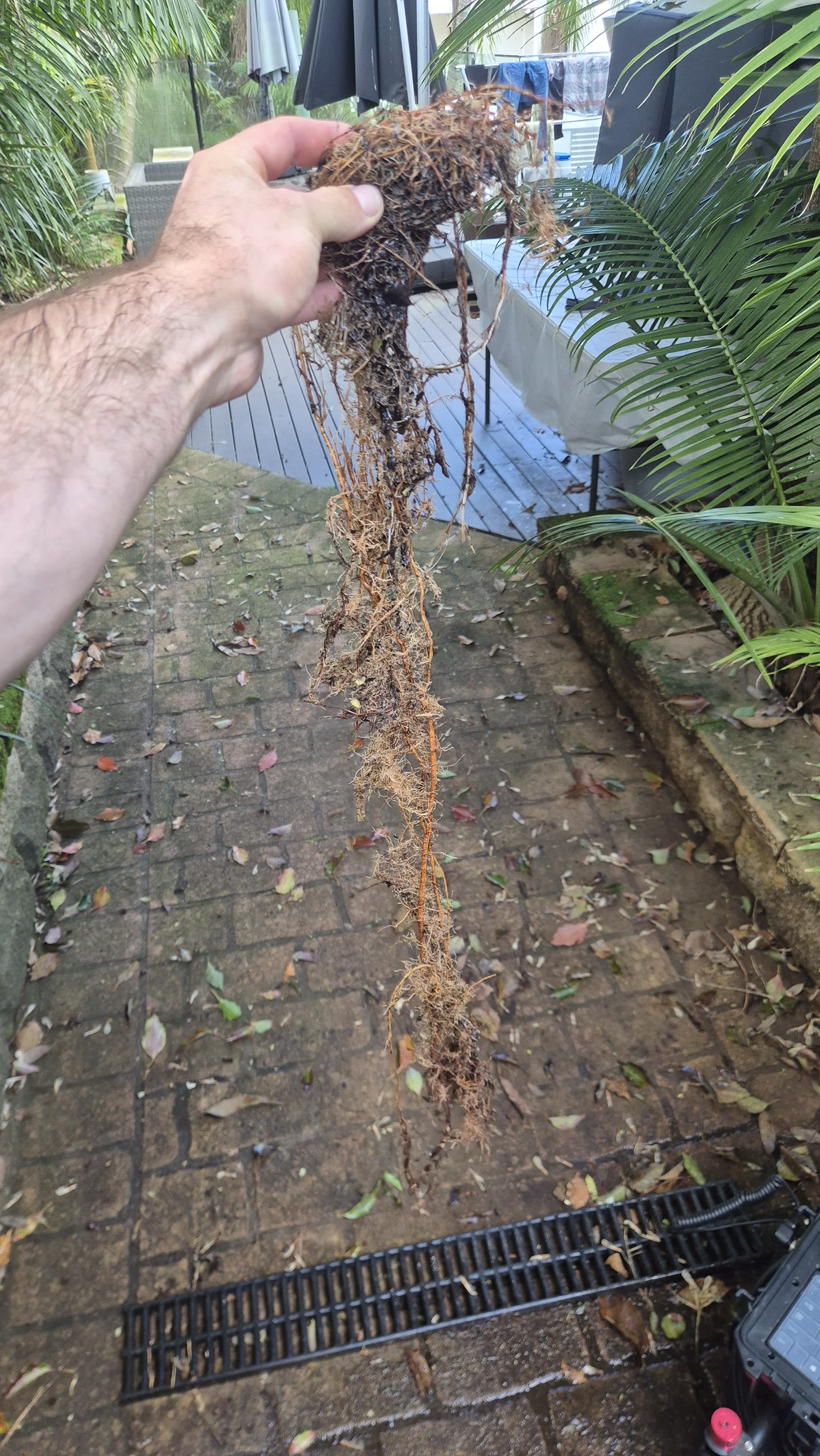
Most people ring me about a blocked drain twice. The first time it is an emergency. The second time, about four months later, it is the same drain, the same gurgle, and the same patch of lawn going soggy.
That second call is the interesting one, because a drain that blocks on a schedule is not bad luck. Something in the pipe is catching everything that goes past it, and clearing the blockage has not changed that.
What a drain machine actually does
A drain machine feeds a cutting head down the line on a flexible cable and chews through whatever is in the way. It is very good at that. Within half an hour the water runs, the toilet stops gurgling, and the job looks finished.
What it has not done is repair anything. If roots came in through a cracked joint, the crack is still a crack. If the pipe has dropped and holds water, it still holds water. The machine removed the symptom and left the cause exactly where it was, which is why the drain blocks again at the same distance down the line.
That is not an argument against clearing it. Sometimes clearing it is the right call. It is an argument against clearing it and never finding out why.
The four things that cause a repeat blockage
In the Hills District, nearly every recurring blockage I see comes down to one of four things.
- Tree roots at a joint. Roots do not break into a sound pipe. They find a joint that has opened up or a hairline crack, follow the moisture in, and then fan out into a mat inside the pipe.
- A sagged section. If the ground under a length of pipe settles, that section stops draining fully and holds water. Solids settle in the dip and build up until the line closes over.
- Failed earthenware. Older clay pipe becomes brittle. Joints shift, sections crack, and the inside surface roughens up so everything catches on it.
- A collapse or a misaligned joint. Less common, but when a section has dropped out of line it leaves a lip that behaves like a sieve.
Each of these looks identical from your kitchen sink. They look completely different on a camera.
Why older Hills District homes get this more than most
A lot of the established streets around Castle Hill, Baulkham Hills and Winston Hills still run on earthenware sewer pipe. It was laid in short lengths, which means a joint every metre or so, and every one of those joints is a place the line can open up.
Add the clay soil through the Hills, which swells and shrinks with the weather and moves the pipe with it, and the mature trees that make those suburbs worth living in, and you have the exact conditions roots look for. Newer homes on PVC have far fewer joints and far fewer of these calls.
None of that means your pipe is about to fail. It means a recurring blockage in an older Hills home is worth looking at properly rather than clearing on repeat.
How you find out which one you have
You put a camera down it. I run a CCTV drain camera on every blocked drain job, after the line is clear, because a camera in a blocked pipe shows you a blockage and nothing else.
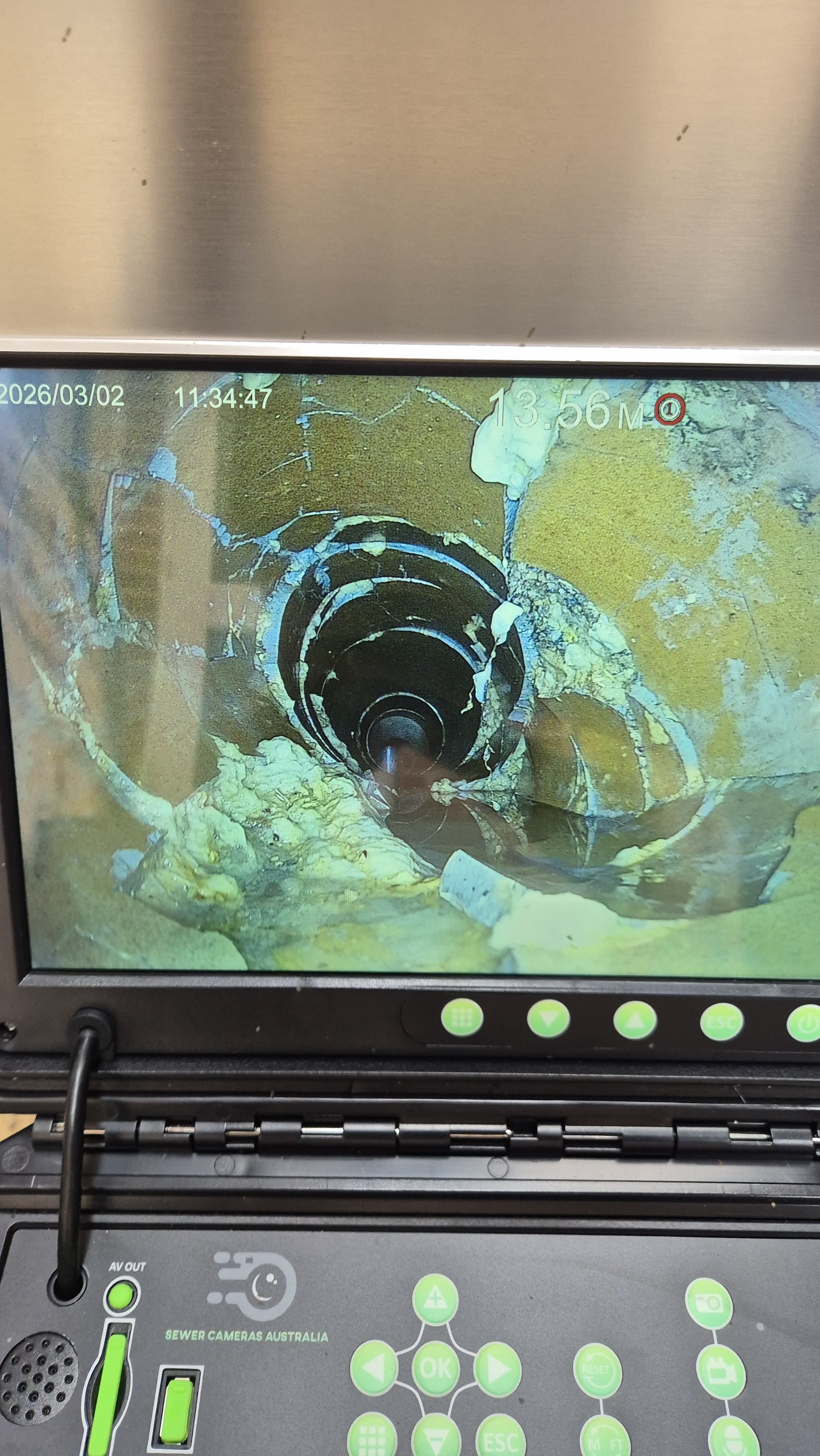
The distance readout is the useful part. This junction sits 13.56 metres along the line.
Two things come out of that. The first is what the problem is, which you can see on the screen rather than take on trust. The second is how far down the line it sits, because the camera counts the metres as it goes.
That distance matters more than people expect. A damaged section 4 metres out is under the lawn. The same damage at 14 metres might be under a driveway or a slab, and that changes what a repair involves and what it costs. Knowing the number before anyone quotes you is the difference between a decision and a guess.
Clearing it again, or fixing it
Once you know what is down there, the choice is usually straightforward.
Clearing it again is reasonable when the intrusion is minor, the pipe is otherwise sound, and you are getting a year or more between blockages. Plenty of people do this for years and it is a perfectly sensible decision.
A repair starts making sense when the gap between blockages keeps shrinking, when the camera shows a section that has actually failed rather than just let roots in, or when the line is backing up into the house. At that point you are paying for the same clear over and over and still owning the problem.
What I will not do is tell you a pipe needs replacing when nobody has looked at it. If the camera turns up something bigger than a blockage, I walk you through the options rather than quoting you straight onto the biggest one.
What you can do before you ring anyone
- Write down the dates. Two blockages eight months apart and two blockages six weeks apart are different problems. Nobody remembers this accurately after the fact.
- Notice which fixtures are affected. If only one sink is slow, the problem is near that fixture. If the toilet gurgles when the shower runs, the blockage is further out on the main line.
- Have a look for the overflow relief gully outside, usually a grate lower than the lowest fixture in the house. If it is pooling, the blockage is past it and the gully is doing its job of keeping sewage out of your bathroom.
- Go easy on the supermarket drain cleaner. It will not touch roots or a sagged pipe, and on old earthenware it is not doing the pipe any favours.
If this sounds like your drain
I am based in Baulkham Hills and cover Castle Hill and the rest of the Hills District, and licence 397982C is mine rather than a company's. I quote before I start, so you know the number before any work happens, and drains do not wait for business hours so the phone gets answered at 2am.
There is more detail on how I handle these on the blocked drains page, and if you are in Castle Hill specifically, the Castle Hill plumber page covers the area.
If what you are seeing is water appearing rather than water not draining away, the two minute meter test will tell you which of the two you have.