A hot water system almost never dies without warning. It gives you months of small hints, and they are easy to ignore right up until someone is standing in a cold shower on a Monday morning.
The useful thing about those hints is that they tell you which of two conversations you are about to have. Some faults are a repair. Some mean the tank itself is going, and no repair holds a tank together.
The warnings worth acting on
- Hot water running out faster than it used to. Often sediment taking up room in the bottom of the tank, or an element working at half capacity.
- Rusty or discoloured water from the hot tap only. If the cold runs clear and the hot does not, the colour is coming from inside your tank.
- Water pooling underneath, or rust creeping up from the base. The one to act on quickest. See below.
- Banging or rumbling while it heats. Sediment on the bottom with water trapped under it. Noisy rather than dangerous, but it tells you the tank has been neglected.
- A pilot light that keeps going out on a gas unit.
- Anything past about ten years old. Not a fault on its own, but it changes how you read every other symptom on this list.
The difference between a drip and a leak
A bit of water near the unit is not automatically bad news, and this is where people either panic early or relax too long.
The relief valve on the side is supposed to release water as the tank heats and the pressure rises. A small discharge from that valve, into its drain line, is the system working. A valve that is dribbling constantly is a valve that needs replacing, which is a cheap job.
Water appearing underneath the tank itself is the other thing entirely. That is the cylinder, and a cylinder does not get better. If rust is coming up from the base and there is damp underneath, you are on borrowed time.
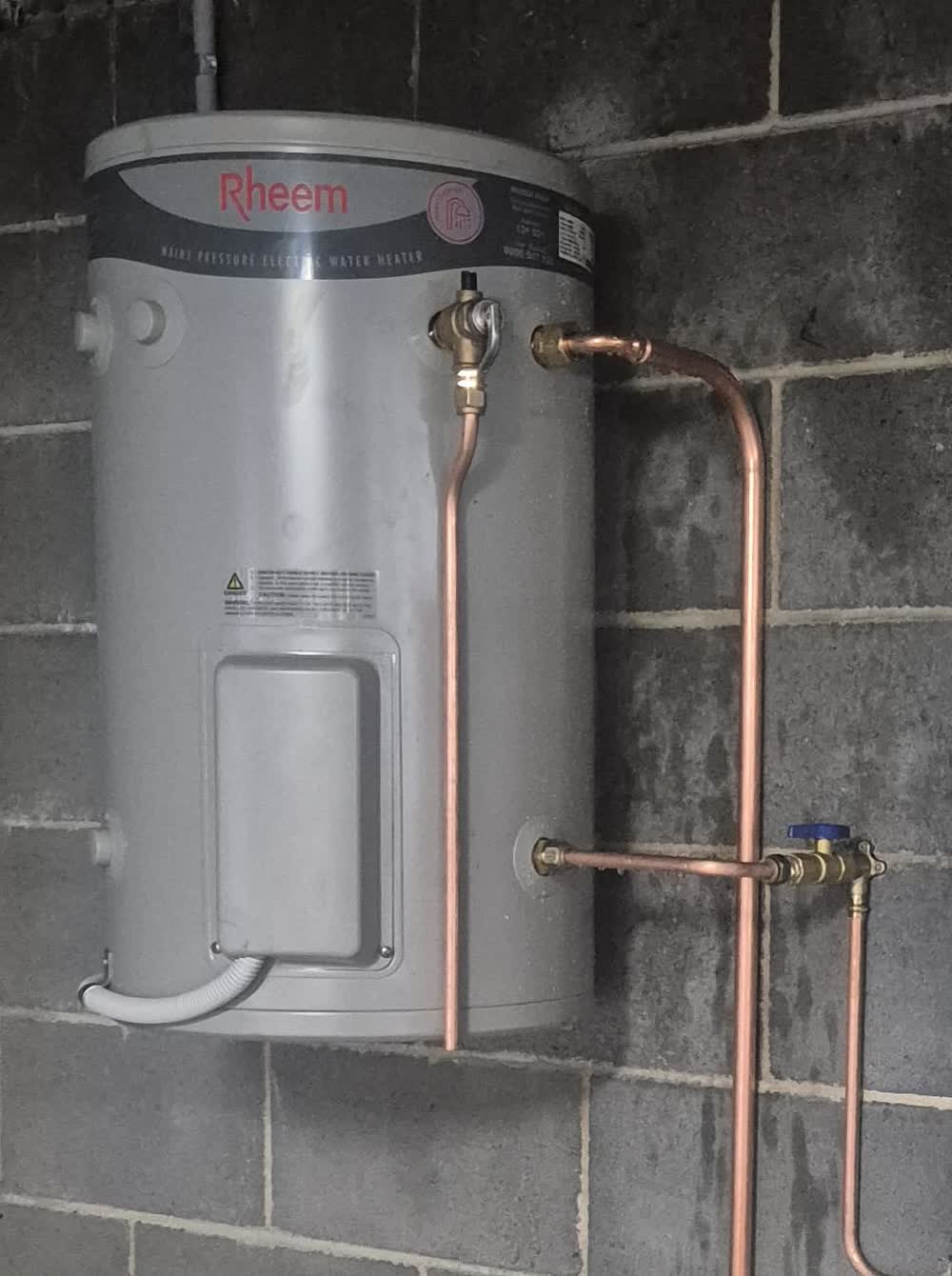
Mains pressure electric unit. The valve on the upper right is the one that is meant to discharge.
Repair or replace
Not every fault means a new system. A failed thermostat, element or valve is a repair, and on a unit under about eight years old a repair is usually the sensible call.
Once the tank has rusted through, though, nothing holds it. At that point replacing it before it lets go costs a lot less than replacing it plus the flooring underneath it, and I would rather tell you that in advance than after.
I will tell you which of the two you are looking at and why. If a repair buys you another few years, that is what I will quote.
What to do while you wait
- If it is actively leaking from the tank, turn off the water supply to the unit and, on an electric system, switch it off at the board. A tank that is emptying into a cupboard does damage fast.
- If the water has just gone cold, check the switchboard first. An element failing can trip the circuit, and sometimes it is only that.
- Do not keep relighting a pilot that will not stay lit. It is telling you something.
- Take a photo of the data plate on the side. Brand, model and capacity are on it, and it saves a round of questions on the phone.
Getting the size right
If you are replacing, it is worth a minute on sizing rather than ordering what is already there. Plenty of undersized systems get swapped like for like, and the household keeps running out of hot water for another decade for no reason.
The number of people in the house, how many bathrooms, and when everyone showers matter more than the badge on the front.
If any of that sounds familiar
I repair and replace hot water across Castle Hill, Baulkham Hills, Kellyville and the rest of the Hills District, and I am a licensed gas fitter as well as a plumber, so gas storage, electric storage and continuous flow are all in scope on one visit.
There is more on the hot water systems page. If what you are actually seeing is water appearing somewhere it should not be, the two minute meter test will tell you whether it is the unit or a pipe.